A promising enterprise deal reaches the final procurement stage. The customer likes the product, pricing is agreed, and implementation discussions have started. Then the security questionnaire arrives. The buyer wants evidence of SOC 2 or ISO 27001 compliance.
That request can decide which security project deserves attention first for an Australian software company entering enterprise markets. If you choose incorrectly, you may spend months preparing evidence that doesn’t meet the customer’s requirements.
Treat a security questionnaire as a prompt to plan rather than something to scramble over. The options narrow quickly once you know what the customer actually needs and by when.
What Does the Customer Actually Require?
The SOC 2 vs ISO 27001 decision shouldn’t begin with whichever framework appears easier to achieve. Begin with the customer’s contract or security requirements. North American SaaS customers frequently request SOC 2 reports, whereas Australian and European enterprise buyers commonly recognize ISO 27001.
These preferences aren’t universal. Certain customers are happy with either framework, but others specify one. An ISO 27001 certificate isn’t automatically an acceptable substitute if a contract explicitly requires SOC 2. Confirm with the buyer, before committing resources, whether equivalent assurance will satisfy the requirement.
Why Certification and Attestation Aren’t the Same Thing
One important distinction in the ISO 27001 vs SOC 2 comparison is what your business receives after the independent assessment. ISO 27001 is an international standard for information security management systems. An accredited certification body assesses the organization and can issue a certificate valid for three years, subject to ongoing surveillance audits. The process for SOC 2 is different.
A licensed CPA firm issues an attestation report after examining controls against the AICPA Trust Services Criteria. A SOC 2 Type 1 report evaluates controls at a particular point in time. Type 2 also assesses how effectively they operate over a defined period. A formal SOC 2 certification doesn’t exist. Customers receive an auditor’s report rather than an ISO-style certificate.
The difference matters when you describe your status to customers. It’s worth being precise about whether you hold a certificate or a report, since procurement teams tend to notice the wording.
Pursuing Both Doesn’t Mean Doing the Work Twice
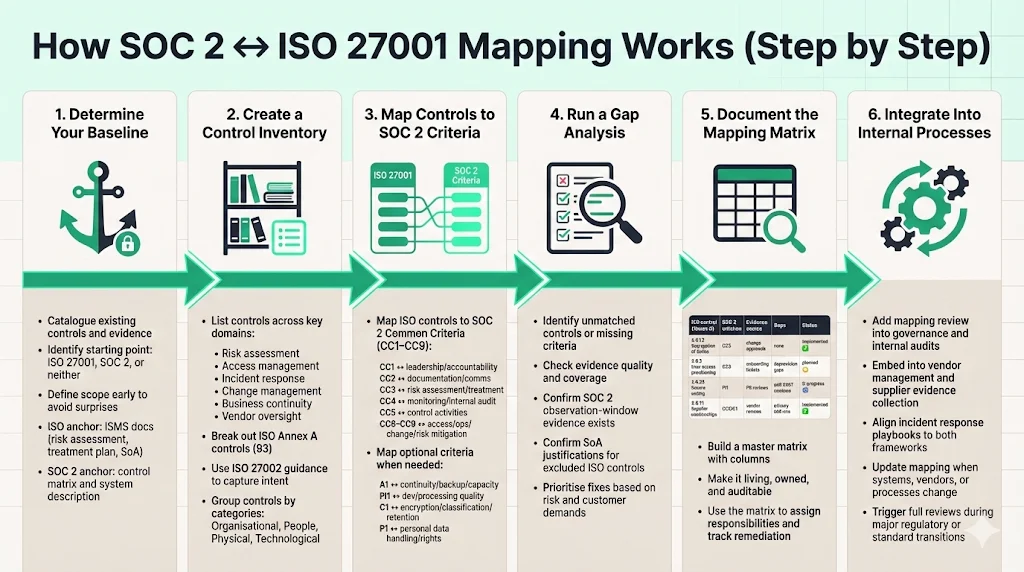
Much of the operational work is shared between the frameworks, though the SOC2 vs ISO 27001 discussion often overlooks it. Both frameworks involve security practices like access management, risk assessment, incident response, supplier oversight, and change management.
Picture a SaaS company that already keeps employee access records, documents security incidents, and reviews important suppliers. Although the requirements and testing methods differ, much of this evidence may support both assessments. Mapping shared controls early lets organizations planning to pursue both frameworks avoid maintaining completely separate evidence collections.
Establishing an ISO 27001 information security management system first gives many businesses a useful foundation for later SOC 2 preparation.
It’s still necessary to check each control against the criteria of the framework being assessed. What satisfies one standard may need extra evidence or a different test to satisfy the other.
Allow for the Time Before and Around the Audit
Audit readiness takes more than writing policies. You need to implement security controls, assign responsibilities, and collect evidence. Australian businesses can get structured compliance support from Siege Cyber, whose programs are designed to achieve audit readiness in approximately three to nine months.
An additional observation period may be required for SOC 2 Type 2 before the independent auditor can issue the report. The duration depends on the scope, existing controls, and evidence requirements. Budgets should also cover independent certification and attestation fees.
Remember internal time: staff will be involved in gathering evidence and answering auditor questions. Agreeing the scope early, including which systems and services are covered, helps keep the timeline and the budget realistic.
Compliance That Helps Beyond the Sales Process
A well-designed compliance program should improve security operations, not merely satisfy a customer questionnaire. Regular access reviews, incident response exercises, employee training, and technical testing can help organizations identify weaknesses and manage risks more consistently.
Within its compliance packages, Siege Cyber provides fixed-price compliance support, Australian-based specialists, and penetration testing.
Businesses comparing ISO 27001 SOC 2 requirements can draw on this support when assessing existing controls, identifying gaps, and preparing for independent assessment.
Choose the Framework That Supports Your Next Move
Prioritize SOC 2 if your immediate opportunity requires it. For customers who mainly operate in Australia or Europe, ISO 27001 may be the more practical place to start. A coordinated approach can reduce duplicated preparation when both markets matter.
Prior to investing, find out what your customers will accept, define the systems covered by the assessment, and understand the complete timeline and cost. What makes a framework right is that it meets your business obligations while helping establish security practices your team can maintain.